Every grain has a specification.Everygrainhasaspecification.
Wheat quality determines how grain is classified, processed, stored and traded. Here is what Kazakhstan grows, how it is graded, and what the numbers on a quality certificate mean.
19.3 Mtwheat harvested in 2025
96%of it soft (bread) wheat
5quality classes in trade
01 / What Kazakhstan grows
Almost all of it is bread wheat.
Kazakhstan's crop is overwhelmingly soft spring wheat, the kind milled into bread flour. Durum, the hard wheat used for semolina and pasta, is a small specialist crop alongside it.
Soft wheat 18.53 Mt
Soft wheat: 18.53 Mt from 11.80 M haDurum: 0.80 Mt from 0.39 M ha
Triticum aestivum
Soft wheat
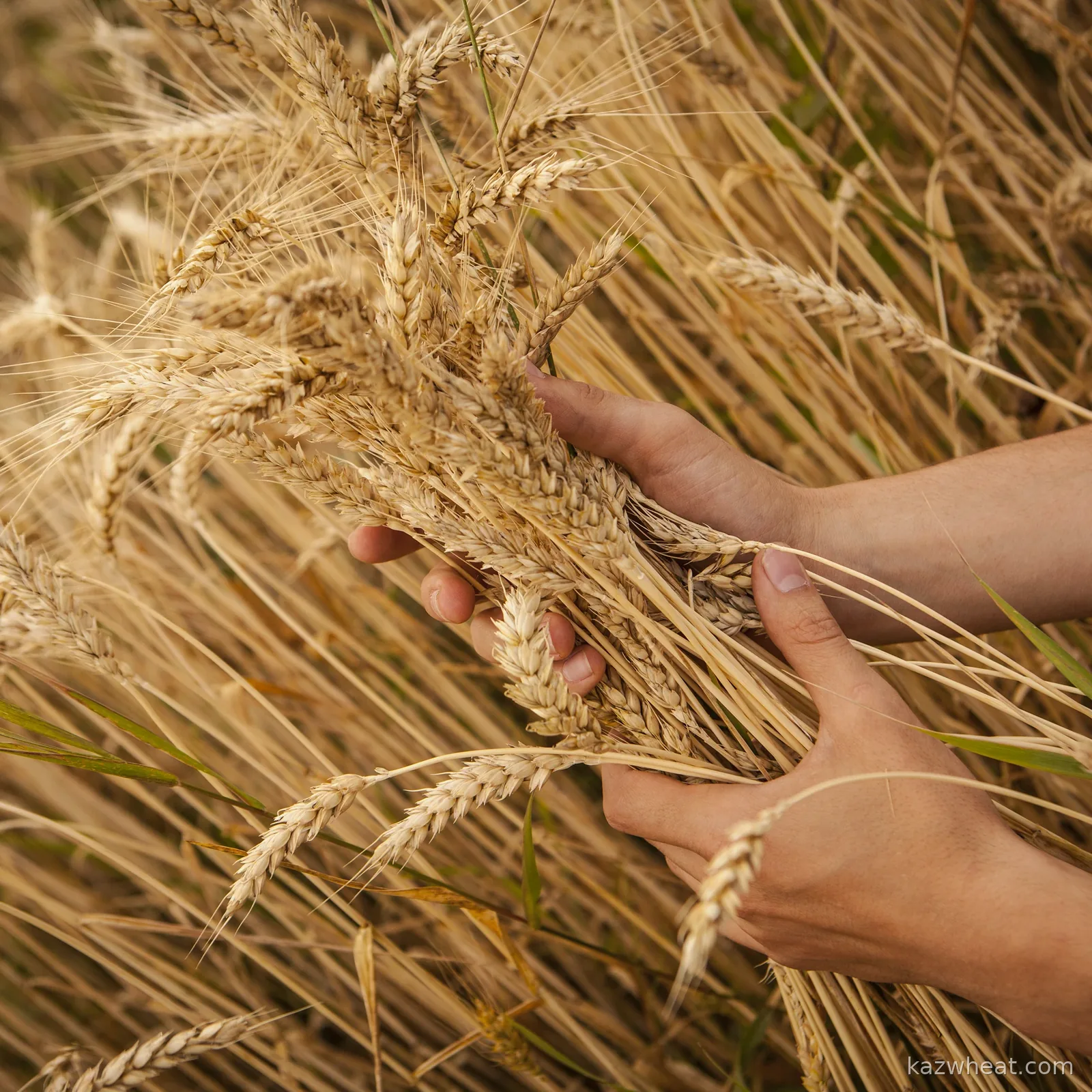
Common or bread wheat, sown in spring across the northern grain belt and harvested from late August. It's milled into flour for bread and baked goods at home and across Central Asia, and Kazakhstan is one of the world's largest flour exporters.
2025 output
18.53 Mt
Change on 2024
+5.5%
Triticum durum
Durum wheat
A harder, high-protein wheat with large amber kernels, milled into semolina for pasta and couscous. In 2025 the area fell by about a third, as farmers moved land into oilseeds and other crops.
Wheat in Kazakhstan is traded in classes 1 to 5, set out in the national wheat standard, ST RK 1046-2008. Classes 1 to 3 are food grade, milling wheat. Classes 4 and 5 are feed quality. Within a class, gluten and falling number move the price.
1Food grade
2Food grade
3Food grade, the main milling class
4Feed quality
5Feed quality
What quality is worth. Prices the state's Food Contract Corporation offered for 2025-crop wheat, October 2025, in tenge per tonne.
Class 3Gluten 27% and above115,000
Class 3Gluten 25 to 27%, falling number from 250 s96,000
Class 3Gluten 25 to 27%, falling number from 200 s94,000
Class 3Gluten 23 to 24%, falling number from 230 s92,000
Class 3Gluten 23 to 24%, falling number from 160 s90,000
DurumVitreousness 60%, falling number from 200 s90,000
Class 4Gluten 20 to 22%, falling number from 200 s82,000
Class 4Gluten 18 to 19%, falling number from 80 s80,000
Class 5Gluten 18%70,000
Classes: USDA FAS GAIN report KZ2026-0003, March 2026, which also lists these purchase prices. The government kept its 2026 class 3 procurement range at 92,000 to 115,000 tenge per tonne (gov.kz, 30 September 2026).
03 / The measurements
Four numbers decide what a lot is worth.
01
Protein
The share of protein in the grain, the first figure a miller looks at. Higher protein wheat makes stronger bread flour. Labs measure it from the grain's nitrogen content, by the Kjeldahl or Dumas method, or quickly by near-infrared.
ISO 20483 (Kjeldahl), ISO 17715 (Dumas)
02
Wet gluten
Wash a dough with salt water and what's left is gluten, the stretchy network that holds gas in bread. In Kazakhstan it is the measure that sets the price within class 3, from 23% up to 27% and above.
ISO 21415
03
Falling number
How many seconds a plunger takes to fall through a heated paste of flour and water. Sprouted grain is full of an enzyme that thins the paste, so it falls fast. Low numbers mean weak baking quality.
The price steps in seconds used in the 2025 purchase tiers. Feed wheat starts as low as 80 s.
ISO 3093 (Hagberg-Perten)
04
Test weight and moisture
Test weight, or nature, is how heavy a fixed volume of grain is, a quick guide to how well filled the kernels are. Moisture is checked at every handover, because damp grain won't store safely.
ISO 7971 (test weight)
04 / Quality in practice
Big crops aren't always the best crops.
2025
The early harvest came in with protein of 11 to 12% and gluten of 14 to 17%, and an unusually high share of class 4 and 5 wheat, the Kazakh Grain Union reported in September 2025. The gap between class 3 and class 4 prices widened to 8,000 to 10,000 tenge a tonne.
2026
A smaller crop came in stronger. About 72% of the soft wheat delivered met class 3, and 48% of tested samples had gluten above 28%, according to the Ministry of Agriculture at the end of the harvest.
2025: Kazakh Grain Union via UkrAgroConsult, 8 September 2025. 2026: Ministry of Agriculture via UkrAgroConsult, 30 October 2026.
05 / Testing and standards
From field to certificate.
Before wheat crosses a border it carries two pieces of paper that matter most: a quality certificate for the lot and a phytosanitary certificate for plant health.
A homogeneous lot
Grain is assessed lot by lot, a quantity of the same quality held in one store or loaded into one set of wagons.
Sampling
Inspectors draw samples from the store or the wagons according to the inspection rules.
Laboratory tests
Protein, gluten, falling number, test weight, moisture and impurities are measured to the standard methods.
Quality certificate
A grain quality certificate is issued for each homogeneous lot, under the Ministry of Agriculture's Order No. 226.
Phytosanitary certificate
The State Inspection Committee in the Agro-Industrial Complex certifies the grain is free of regulated pests before export.
Quality inspection: Ministry of Agriculture Order No. 226 (summary). Phytosanitary certificates: gov.kz public service 3372. Buyers often add their own independent inspection on top.